


Various - Classic Rock 1968 (CD, Comp) (Near Mint (NM or M-))
Media Condition: Near Mint (NM or M-)
Sleeve Condition: Near Mint (NM or M-)
Country: US
Released: 1988
Genre: Rock, Funk / Soul
Style: Rock & Roll, Soul, Rhythm & Blues, Psychedelic Rock, Funk, Classic Rock
Location:
Comments:
Notes:
This variant is the ladies-in-car artwork.
Other variants include a guys-in-the-weeds artwork with a Mould SID Code, and the same guys-in-the-weeds artwork but with no Mould SID Code. The audio is identical on all of these variants.
Track durations obtained from software.
Volume 4 of a 30 volume set.
Complete liner notes:
Against a backdrop of incredible political and social turmoil - the escalation of the Vietnam conflict, the assassinations of Martin Luther King and Robert Kennedy, race riots across the nation, and street battles outside the Democratic National Convention in Chicago - rock prospered in 1968 as never before. Billboard reported that in 1967 consumers had spent more than one billion dollars on records, and that albums had outsold singles, both firsts for the industry. Though 45s and AM radio were hardly dead, the LP had emerged as the leading recording medium, and the rise of "underground" FM radio stations reinforced the significance of this format.
Rock was obviously the dominant entertainment form of the young, but the music had grown in so many different directions that it was impossible to speak of a unified rock audience. The cultural schisms plaguing America were mirrored by the proliferation of musical subgenres: folk-rock, country-rock, hard rock, psychedelic rock, art-rock, blues-rock, bubble gum and plain old pop. As Sylvester Stewart, a.k.a. Sly Stone, put it, "Different strokes for different folks."
No group bridged the gaps between soul, pop and counterculture factions more successfully than San Francisco's Sly and the Family Stone. With a show-stopping combination of funky rhythms, idealistic messages, outrageous costumes and wild choreography, this sexually and racially integrated septet ushered soul music into a more artistically progressive era. In Everyday People, Sly Stone revolutionized R & B by creating a democracy of sound where numerous voices and instruments carried on a kinetic musical dialogue.
Even Motown was affected by Stone's groundbreaking psychedelic-soul fusion and became more musically adventurous. Producer Norman Whitfield wrote a new page of Motown history in Cloud Nine by the Temptations. With lead singer David Ruffin gone (replaced by Dennis Edwards), Whitfield now used all five singers equally, letting their voices pop in and out of the song's relentless funk bottom. The lyrics, which contrast the bleak reality of ghetto life with the escape offered by drugs, were also quite daring by Motown standards. The Temps' Otis Williams later remarked, "When that came out the establishment was a little bit stunned. They were used to us singing Ol' Man River and Ain't Too Proud to Beg, but suddenly we were into a heavier kind of song."
Motown suffered a loss in 1968 when its top songwriting and production team, Holland-Dozier-Holland, left the label amid a flurry of lawsuits. To compensate, Motown enlisted four songwriters and a five-man production team to create Love Child for the Supremes. This uncharacteristic slice of social commentary about illegitimate children gave the Supremes another No. 1 hit. On The Ed Sullivan Show, the group reinforced the song's message by shedding their usual glamorous outfits in favor of cutoffs, sweatshirts and bare feet.
Aretha Franklin, the most successful soul singer of the '60s, chalked up nine top-10 hits in 1967 and 1968, including Think and Since You've Been Gone. In Think, Franklin's piano introduction and her excited climb through the chorus of "freedom ... freedom .. . freedom" make clear her gospel roots. In the 1980 film The Blues Brothers, Franklin appeared as the proprietor of a diner and raised the roof with a scintillating performance of the song.
If soul music found its queen in Aretha Franklin, it lost its crown prince when Otis Redding died in a plane crash at Lake Monona, outside of Madison, Wisconsin. Ironically, this occurred on December 10, 1967, exactly three years after the death of Redding's hero, Sam Cooke. Redding's sweat-soaked performance at the Monterey Pop Festival earlier that year had astonished the largely hippie audience, and he was on the verge of a major commercial breakthrough when tragedy struck. Unfortunately, his only big pop hit was the posthumously released (Sittin' on) The Dock of the Bay, a wistful, folkish composition quite different from the down-home soul that had already made Redding a top star in black America and Europe.
One of the pallbearers at his funeral was Johnnie Taylor, who replaced Sam Cooke in the Soul Stirrers when Cooke went pop in 1957. Like Redding, Taylor eventually recorded for the Memphis-based Stax/Volt label. His Who's Making Love ("to your old lady while you are out making love") typified the earthy concerns of Southern soul music. Stax's dynamic duo of Sam and Dave also scored a big 1968 hit with the celebratory I Thank You.
"Blue-eyed" soul also flourished as the Rascals continued their string of hits with A Beautiful Morning and the Box Tops returned to the top 10 with Cry Like a Baby. Many white bands had absorbed the blues, and such groups as Big Brother and the Holding Company, the Paul Butterfield Blues Band, Canned Heat and John Mayall's Bluesbreakers introduced the sound to receptive rock audiences. This stimulated interest in the real thing, and blues greats Muddy Waters, B. B. King and Albert King, among others, attracted a large white following through their appearances at the hippest rock concert halls, including the two Fillmores, West and East.
ln Los Angeles, blues scholar Alan "Blind Owl" Wilson and record collector Bob "the Bear" Hite formed Canned Heat as a jug band in 1965. They took the name from Tommy Johnson's Canned Heat Blues and landed their first hit with an adaptation of a blues number by Floyd Jones, On the Road Again. Thanks to Wilson's harmonica playing and fragile falsetto delivery, Canned Heat was unique in its ability to capture the flavor of prewar country blues within a rock framework.
Status Quo from London pursued a decidedly more psychedelic sound in their only real American hit, Pictures of Matchstick Men, which was pulled off their fancifully titled British debut album, Picturesque Matchstickable Messages. The band prospered in England throughout the '70s as a boogie band, earning itself the derogatory tag "the poor man's Canned Heat." For pure flower-power mysticism, however, it was hard to top England's trippy minstrel, Donovan Leitch. His Hurdy Gurdy Man arose from a dream he had about a medieval musician in rags winding the droning stringed instrument as he moved across an ocean. In the song a tambura, a long-necked Indian lute, evokes the hurdy-gurdy, and Jeff Beck answers on electric guitar.
After a number of teen-oriented hits such as Hanky Panky and Mony Mony, Tommy James and the Shondells adopted a more sophisticated, psychedelic approach on Crimson and Clover. The Monkees also became more ambitious once they fired musical director Don Kirshner and started writing more of their own material. Valleri, though, was a Tommy Boyce-Bobby Hart composition the group had originally performed on a 1967 episode of their TV show but did not record. After some DJs taped the show and began airing the song, Monkees fans wrote Colgems Records demanding its release and, somewhat reluctantly, the group cut it.
Despite their surly image and thunderous hit, Wild Thing, the Troggs softened up and got in step with the love and peace generation with a hit ballad, Love Is All Around. There was no shortage of harder sounds, however, with groups like Iron Butterfly and Blue Cheer taking rock to decibel levels previously associated only with jet airplanes. Steppenwolf helped name this phenomenon when they sang about "heavy metal thunder" in their famous biker anthem, Born to Be Wild, which was later featured in the film classic Easy Rider.
The hardest, fastest, loudest and most musically proficient blues-based band of the era undoubtedly was England's Cream, led by guitar hero Eric Clapton. This power trio became the prototype for thousands of three-piece hard-rock bands, few of which ever matched Cream's flair for the heavy riff and the flamboyant solo. Both bassist Jack Bruce and drummer Ginger Baker were jazz-trained musicians who freed their instruments from the traditional role of mere rhythmic support. Though the group's live performances were largely improvisatory, their two biggest chart successes, Sunshine of Your Love and White Room, revealed a more disciplined, economical approach.
In many respects , 1968 was a year of extremes and contrasts. While the now-psychedelicized Beatles and the hippies pushed rock toward a visionary future, its past surfaced in unexpected ways. After a long battle with drugs, the once-swaggering Dion emerged as an introspective folkie with Abraham, Martin and John. A nearly forgotten Elvis Presley returned as the leather-clad King of Rock 'n' Roll in a triumphant TV special. And Frankie Lymon, once the 13-year-old sensation who helped bring rock 'n' roll to life in 1956 with Why Do Fools Fall in love, died of a drug overdose at 26, virtually forgotten. Perhaps Jim Morrison of the Doors captured the spirit of the times best when he sang, "Strange days have found us."
- Joe Sasfy
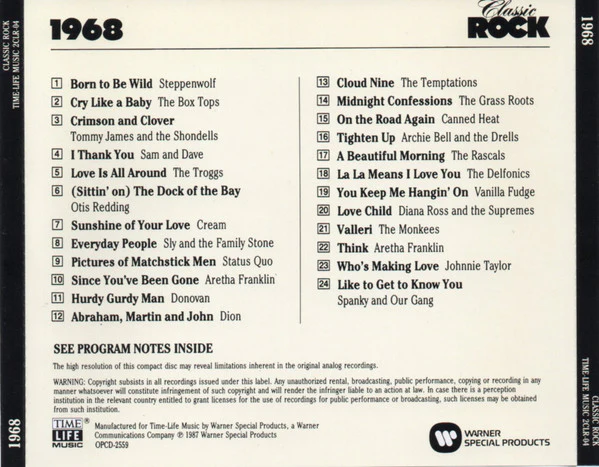
1. Steppenwolf - Born To Be Wild 3:29
2. Box Tops - Cry Like A Baby 2:34
3. Tommy James & The Shondells - Crimson And Clover 5:12
4. Sam & Dave - I Thank You 2:52
5. The Troggs - Love Is All Around 2:58
6. Otis Redding - (Sittin' On) The Dock Of The Bay 2:44
7. Cream (2) - Sunshine Of Your Love 4:11
8. Sly & The Family Stone - Everyday People 2:23
9. Status Quo - Pictures Of Matchstick Men 3:10
10. Aretha Franklin - Since You've Been Gone 2:23
11. Donovan - Hurdy Gurdy Man 3:13
12. Dion (3) - Abraham, Martin And John 3:22
13. The Temptations - Cloud Nine 3:32
14. The Grass Roots - Midnight Confessions 2:49
15. Canned Heat - On The Road Again 3:26
16. Archie Bell & The Drells - Tighten Up 3:12
17. The Rascals - A Beautiful Morning 2:34
18. The Delfonics - La La Means I Love You 3:22
19. Vanilla Fudge - You Keep Me Hangin' On 3:01
20. Diana Ross, The Supremes - Love Child 2:59
21. The Monkees - Valleri 2:22
22. Aretha Franklin - Think 2:17
23. Johnnie Taylor - Who's Making Love 2:49
24. Spanky & Our Gang - Like To Get To Know You 3:09
Barcode and Other Identifiers:
Matrix / Runout 10 OPCD 2559-2 SRC-01 M2-S3
Manufactured For Time Life Music
Manufactured By Warner Special Products
Record Company Warner Communications
Phonographic Copyright (p) Warner Special Products
Pressed By Specialty Records Corporation
Engineered At Fry Systems
Remastered At Masterdisk
Copyright (c) Time-life Books Inc.
Record Company Time Inc.
Original: $10.00
-65%$10.00
$3.50Product Information
Product Information
Shipping & Returns
Shipping & Returns
Description
Media Condition: Near Mint (NM or M-)
Sleeve Condition: Near Mint (NM or M-)
Country: US
Released: 1988
Genre: Rock, Funk / Soul
Style: Rock & Roll, Soul, Rhythm & Blues, Psychedelic Rock, Funk, Classic Rock
Location:
Comments:
Notes:
This variant is the ladies-in-car artwork.
Other variants include a guys-in-the-weeds artwork with a Mould SID Code, and the same guys-in-the-weeds artwork but with no Mould SID Code. The audio is identical on all of these variants.
Track durations obtained from software.
Volume 4 of a 30 volume set.
Complete liner notes:
Against a backdrop of incredible political and social turmoil - the escalation of the Vietnam conflict, the assassinations of Martin Luther King and Robert Kennedy, race riots across the nation, and street battles outside the Democratic National Convention in Chicago - rock prospered in 1968 as never before. Billboard reported that in 1967 consumers had spent more than one billion dollars on records, and that albums had outsold singles, both firsts for the industry. Though 45s and AM radio were hardly dead, the LP had emerged as the leading recording medium, and the rise of "underground" FM radio stations reinforced the significance of this format.
Rock was obviously the dominant entertainment form of the young, but the music had grown in so many different directions that it was impossible to speak of a unified rock audience. The cultural schisms plaguing America were mirrored by the proliferation of musical subgenres: folk-rock, country-rock, hard rock, psychedelic rock, art-rock, blues-rock, bubble gum and plain old pop. As Sylvester Stewart, a.k.a. Sly Stone, put it, "Different strokes for different folks."
No group bridged the gaps between soul, pop and counterculture factions more successfully than San Francisco's Sly and the Family Stone. With a show-stopping combination of funky rhythms, idealistic messages, outrageous costumes and wild choreography, this sexually and racially integrated septet ushered soul music into a more artistically progressive era. In Everyday People, Sly Stone revolutionized R & B by creating a democracy of sound where numerous voices and instruments carried on a kinetic musical dialogue.
Even Motown was affected by Stone's groundbreaking psychedelic-soul fusion and became more musically adventurous. Producer Norman Whitfield wrote a new page of Motown history in Cloud Nine by the Temptations. With lead singer David Ruffin gone (replaced by Dennis Edwards), Whitfield now used all five singers equally, letting their voices pop in and out of the song's relentless funk bottom. The lyrics, which contrast the bleak reality of ghetto life with the escape offered by drugs, were also quite daring by Motown standards. The Temps' Otis Williams later remarked, "When that came out the establishment was a little bit stunned. They were used to us singing Ol' Man River and Ain't Too Proud to Beg, but suddenly we were into a heavier kind of song."
Motown suffered a loss in 1968 when its top songwriting and production team, Holland-Dozier-Holland, left the label amid a flurry of lawsuits. To compensate, Motown enlisted four songwriters and a five-man production team to create Love Child for the Supremes. This uncharacteristic slice of social commentary about illegitimate children gave the Supremes another No. 1 hit. On The Ed Sullivan Show, the group reinforced the song's message by shedding their usual glamorous outfits in favor of cutoffs, sweatshirts and bare feet.
Aretha Franklin, the most successful soul singer of the '60s, chalked up nine top-10 hits in 1967 and 1968, including Think and Since You've Been Gone. In Think, Franklin's piano introduction and her excited climb through the chorus of "freedom ... freedom .. . freedom" make clear her gospel roots. In the 1980 film The Blues Brothers, Franklin appeared as the proprietor of a diner and raised the roof with a scintillating performance of the song.
If soul music found its queen in Aretha Franklin, it lost its crown prince when Otis Redding died in a plane crash at Lake Monona, outside of Madison, Wisconsin. Ironically, this occurred on December 10, 1967, exactly three years after the death of Redding's hero, Sam Cooke. Redding's sweat-soaked performance at the Monterey Pop Festival earlier that year had astonished the largely hippie audience, and he was on the verge of a major commercial breakthrough when tragedy struck. Unfortunately, his only big pop hit was the posthumously released (Sittin' on) The Dock of the Bay, a wistful, folkish composition quite different from the down-home soul that had already made Redding a top star in black America and Europe.
One of the pallbearers at his funeral was Johnnie Taylor, who replaced Sam Cooke in the Soul Stirrers when Cooke went pop in 1957. Like Redding, Taylor eventually recorded for the Memphis-based Stax/Volt label. His Who's Making Love ("to your old lady while you are out making love") typified the earthy concerns of Southern soul music. Stax's dynamic duo of Sam and Dave also scored a big 1968 hit with the celebratory I Thank You.
"Blue-eyed" soul also flourished as the Rascals continued their string of hits with A Beautiful Morning and the Box Tops returned to the top 10 with Cry Like a Baby. Many white bands had absorbed the blues, and such groups as Big Brother and the Holding Company, the Paul Butterfield Blues Band, Canned Heat and John Mayall's Bluesbreakers introduced the sound to receptive rock audiences. This stimulated interest in the real thing, and blues greats Muddy Waters, B. B. King and Albert King, among others, attracted a large white following through their appearances at the hippest rock concert halls, including the two Fillmores, West and East.
ln Los Angeles, blues scholar Alan "Blind Owl" Wilson and record collector Bob "the Bear" Hite formed Canned Heat as a jug band in 1965. They took the name from Tommy Johnson's Canned Heat Blues and landed their first hit with an adaptation of a blues number by Floyd Jones, On the Road Again. Thanks to Wilson's harmonica playing and fragile falsetto delivery, Canned Heat was unique in its ability to capture the flavor of prewar country blues within a rock framework.
Status Quo from London pursued a decidedly more psychedelic sound in their only real American hit, Pictures of Matchstick Men, which was pulled off their fancifully titled British debut album, Picturesque Matchstickable Messages. The band prospered in England throughout the '70s as a boogie band, earning itself the derogatory tag "the poor man's Canned Heat." For pure flower-power mysticism, however, it was hard to top England's trippy minstrel, Donovan Leitch. His Hurdy Gurdy Man arose from a dream he had about a medieval musician in rags winding the droning stringed instrument as he moved across an ocean. In the song a tambura, a long-necked Indian lute, evokes the hurdy-gurdy, and Jeff Beck answers on electric guitar.
After a number of teen-oriented hits such as Hanky Panky and Mony Mony, Tommy James and the Shondells adopted a more sophisticated, psychedelic approach on Crimson and Clover. The Monkees also became more ambitious once they fired musical director Don Kirshner and started writing more of their own material. Valleri, though, was a Tommy Boyce-Bobby Hart composition the group had originally performed on a 1967 episode of their TV show but did not record. After some DJs taped the show and began airing the song, Monkees fans wrote Colgems Records demanding its release and, somewhat reluctantly, the group cut it.
Despite their surly image and thunderous hit, Wild Thing, the Troggs softened up and got in step with the love and peace generation with a hit ballad, Love Is All Around. There was no shortage of harder sounds, however, with groups like Iron Butterfly and Blue Cheer taking rock to decibel levels previously associated only with jet airplanes. Steppenwolf helped name this phenomenon when they sang about "heavy metal thunder" in their famous biker anthem, Born to Be Wild, which was later featured in the film classic Easy Rider.
The hardest, fastest, loudest and most musically proficient blues-based band of the era undoubtedly was England's Cream, led by guitar hero Eric Clapton. This power trio became the prototype for thousands of three-piece hard-rock bands, few of which ever matched Cream's flair for the heavy riff and the flamboyant solo. Both bassist Jack Bruce and drummer Ginger Baker were jazz-trained musicians who freed their instruments from the traditional role of mere rhythmic support. Though the group's live performances were largely improvisatory, their two biggest chart successes, Sunshine of Your Love and White Room, revealed a more disciplined, economical approach.
In many respects , 1968 was a year of extremes and contrasts. While the now-psychedelicized Beatles and the hippies pushed rock toward a visionary future, its past surfaced in unexpected ways. After a long battle with drugs, the once-swaggering Dion emerged as an introspective folkie with Abraham, Martin and John. A nearly forgotten Elvis Presley returned as the leather-clad King of Rock 'n' Roll in a triumphant TV special. And Frankie Lymon, once the 13-year-old sensation who helped bring rock 'n' roll to life in 1956 with Why Do Fools Fall in love, died of a drug overdose at 26, virtually forgotten. Perhaps Jim Morrison of the Doors captured the spirit of the times best when he sang, "Strange days have found us."
- Joe Sasfy
1. Steppenwolf - Born To Be Wild 3:29
2. Box Tops - Cry Like A Baby 2:34
3. Tommy James & The Shondells - Crimson And Clover 5:12
4. Sam & Dave - I Thank You 2:52
5. The Troggs - Love Is All Around 2:58
6. Otis Redding - (Sittin' On) The Dock Of The Bay 2:44
7. Cream (2) - Sunshine Of Your Love 4:11
8. Sly & The Family Stone - Everyday People 2:23
9. Status Quo - Pictures Of Matchstick Men 3:10
10. Aretha Franklin - Since You've Been Gone 2:23
11. Donovan - Hurdy Gurdy Man 3:13
12. Dion (3) - Abraham, Martin And John 3:22
13. The Temptations - Cloud Nine 3:32
14. The Grass Roots - Midnight Confessions 2:49
15. Canned Heat - On The Road Again 3:26
16. Archie Bell & The Drells - Tighten Up 3:12
17. The Rascals - A Beautiful Morning 2:34
18. The Delfonics - La La Means I Love You 3:22
19. Vanilla Fudge - You Keep Me Hangin' On 3:01
20. Diana Ross, The Supremes - Love Child 2:59
21. The Monkees - Valleri 2:22
22. Aretha Franklin - Think 2:17
23. Johnnie Taylor - Who's Making Love 2:49
24. Spanky & Our Gang - Like To Get To Know You 3:09
Barcode and Other Identifiers:
Matrix / Runout 10 OPCD 2559-2 SRC-01 M2-S3
Manufactured For Time Life Music
Manufactured By Warner Special Products
Record Company Warner Communications
Phonographic Copyright (p) Warner Special Products
Pressed By Specialty Records Corporation
Engineered At Fry Systems
Remastered At Masterdisk
Copyright (c) Time-life Books Inc.
Record Company Time Inc.