

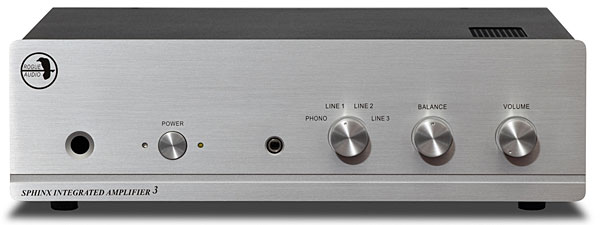
I am proud of the fact that my first review for Stereophile was of a modestly priced integrated amplifier called the Rogue Audio Sphinx. Specified at 100Wpc into 8 ohms, 200Wpc into 4 ohms (footnote 1), it played the KEF LS50s like it was made for them. It was simple and handsome and cost only $1295, phono stage included.
La morte della ragione (24/176.4 FLAC Alpha/Qobuz) is my kind of music. I love the sensuality and mind-body connectedness of these early instrumental compositions by the likes of Josquin Des Prés, John Dunstable, and my favorite composer of all time, Anonymous. Using the HoloAudio May DAC, I streamed this recording through both the old and new Sphinx. The original Sphinx played these songs enjoyably but with an almost imperceptible slipping-clutch effect: Some of the bite of the flute's top octave disappeared, and the midrange blurred just slightly. In contrast, the improved Sphinx V3 is equipped with a no-slip competition clutch: It delivered a good amount of leading-edge bite and trailing-edge flow. Bass felt quicker and more articulate. The V3 displayed a fun, taut energy the original did not have.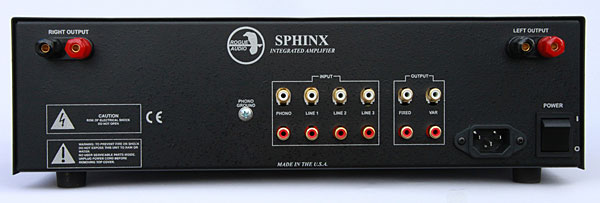
I chose the Sphinx because it was a hybrid tube–class-D design that, to my ears, blended French-wine tube flavor with the grip and authority of class-D solid-stateness. The Sphinx was proletariat, not patrician, but it still showed me the merry music of Paris during La Belle Époque. With the LS50s, a VPI Traveler turntable, Ortofon 2M Red phono cartridge, Oppo CD player, and some AudioQuest wire, the entire analog and digital system cost less than $5k but delivered pleasure like a good five-figure hi-fi.
The latest version of the Rogue Sphinx is called the "V3," and it looks exactly the same as the original (hallelujah!), but it costs $300 more ($1595) and includes a cool-cat clear-plastic "skeleton" remote with only three buttons: up and down volume, plus mute.
The Sphinx V3 is an old-school, 25lb, made-in-America integrated amplifier with three line-level inputs, an RIAA phono stage (with adjustable loading and selectable 44/60dB of gain), a balance control (!!), and a 12AU7-based mu-follower preamplifier stage driving a 100Wpc (into 8 ohm), class-D, solid-state power amplifier with what sounds to me like a substantial linear power supply.
I asked Rogue Audio's chief-of-everything Mark O'Brien to explain all the changes since I reviewed the original Sphinx in 2014. "The V2 saw an updated phono section, new amplifiers in the headphone circuit, circuit layout improvements that lowered the noise floor, and a DC offset filter . . . added to the AC power supply," he replied by email.
"The V3 got a completely new MM/MC phono section that is a somewhat scaled down version of what goes into our Triton II standalone phono. FYI, I think I must have tried twenty versions of this circuit before I got it to work the way I wanted it to. The V3 also got a completely new headphone circuit that is based on discrete MOSFET devices as opposed to the chip amps in the earlier version. We also upgraded some of the components and improved the power supply sections feeding the output modules."
Listening
La morte della ragione (24/176.4 FLAC Alpha/Qobuz) is my kind of music. I love the sensuality and mind-body connectedness of these early instrumental compositions by the likes of Josquin Des Prés, John Dunstable, and my favorite composer of all time, Anonymous. Using the HoloAudio May DAC, I streamed this recording through both the old and new Sphinx. The original Sphinx played these songs enjoyably but with an almost imperceptible slipping-clutch effect: Some of the bite of the flute's top octave disappeared, and the midrange blurred just slightly. In contrast, the improved Sphinx V3 is equipped with a no-slip competition clutch: It delivered a good amount of leading-edge bite and trailing-edge flow. Bass felt quicker and more articulate. The V3 displayed a fun, taut energy the original did not have.
The Ortofon 2M Red phono cartridge that I used in my original Sphinx report did not wear well with me—it played a little hard and generalized—but folks, when I installed the Ortofon 2M Black moving-magnet phono cartridge and played it through the V3's phono input, it was one of those "Wow dang! No way . . . this is not possible" moments.
That wow-dang moment was almost an accident. I woke up one plague-silenced morning in May and said, "Okay, today I listen to the Sphinx phono stage." I wanted to use a popular moving-magnet cartridge that most people know and that many Sphinx V3 owners might aspire to for their own systems. I chose the venerable, $755 Ortofon 2M Black. While fastening the Black to the Jelco TK-850M tonearm on the J.Sikora Initial turntable (see Gramophone Dreams, June 2020), I wondered, will this combo show a budding phonophile the true virtues of analog? I hope so. I knew of course that the 2M Black's Shibata stylus would excavate a tsunami of detail. I just needed the phono stage to deliver that tsunami without loss. The speakers were Harbeth M30.2s.
I wanted to try a record everybody knew, so I put on Mobile Fidelity Sound Lab's reissue of Miles Davis's In a Silent Way (MFSL1 – 377), which I think sounds more sparkly, spirited, and spatially coherent than the original. Before I could even sit down, the newly installed 2M Black was making Miles sound like he did on the horns in the Salt Cellar System: Think dense, vibrating air with a radiant energy—highly tactile and substantially present in my room. Images of performers had dense bodies. I never expected, nor had I experienced, this kind of horn-like vividosity from the normally staid, monitor-like Harbeth M30.2s—or from a $1595 integrated amplifier (including phono stage) and a $755 MM cartridge.
Then I asked myself, what moving-coil cartridges would the average Rogue Sphinx customer probably choose? The first one to jump into my head was the Hana EL. This overachieving, $475, low-output (0.5mV/1kHz) moving coil features alnico magnets and an aluminum cantilever with an elliptical stylus profile. It tracks at 2gm and has a 30 ohm impedance and a suggested load of " >400 ohms."
Changing the cartridge load and phono-stage gain settings is easy, but you must remove the amp cover to do it. Then, simply move the easy-to-spot slide switches from 44dB gain (for MM) to 60dB (for MC)—and then choose the load. The Hana EL specifies a load of greater than 400 ohms, but the two closest choices were 300 ohms and 1k ohm. I experimented with both and preferred the lower, heavier load: 300 ohms.
On In a Silent Way , the Hana EL did not generate as much radiant, glowing energy as the Ortofon 2M Black; instead, it surrounded Miles's trumpet and Herbie Hancock's keyboards with a more restrained but burnished glow that let my mind wander through the myriad polyrhythms and chord changes. The Hana EL was less detailed and transparent than the 2M Black, but it countered with an easygoing, tube-like, musical charm.
I connected the $995 Mytek HiFi Liberty DAC into the $1595 Rogue Sphinx V3 using Cardas Iridium interconnect ($250/1m pair) and used Cardas Clear Cygnus loudspeaker cable (about $1319/2m pair) to drive the $1400/pair Magnepan .7 quasi-ribbon panel speakers.
Except for the Schiit Ragnarok, I can't remember getting excited about any headphone amp included with any integrated amp. But Mark O'Brien said the V3 has "a completely new headphone circuit based on discrete MOSFET devices." He added, "I have used it with a variety of headphones, and I am pretty sure it will drive most of the difficult ones out there." So, as always, I started by using HiFMan's venerable but hard-to-drive HE6se ($1299) planar-magnetic, open-back headphones. The HE6se are only 83.5dB/mW sensitive with a 50 ohm impedance. They need gain and power from an amplifier. The Sphinx drove them to only moderate volumes. The sound was sweet and detailed but not tight and lively.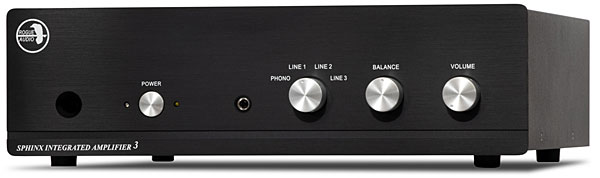
The Rogue Sphinx V3 is an unpretentious working-person's amplifier. It delivers music with an eager expressive energy, in concert with a forgiving musical nature.
The Sphinx V3's MM/MC phono input did proclaim the virtues of analog.
Back to the Maggies
I connected the $995 Mytek HiFi Liberty DAC into the $1595 Rogue Sphinx V3 using Cardas Iridium interconnect ($250/1m pair) and used Cardas Clear Cygnus loudspeaker cable (about $1319/2m pair) to drive the $1400/pair Magnepan .7 quasi-ribbon panel speakers.
This complete under-$6000 system made music flow and pulse via a transparent, super-detailed soundstage that filled half my room. It made recordings sound corporeal and overtly sensuous.
After J.S. Bach, the first classical composer who really captured my attention was Claude Debussy. I was a stoner-artist, and I loved him for his sensuous, painterly chromaticism and the way light flickered through his compositions. Today, he is marketed as drowsy mood music. No matter. I still need a good stereo to intoxicate me with his washes of rich tones, especially on piano. I experienced no New-Age drowsiness when Russian pianist Nikolai Lugansky made "L'Isle joyeuse" (Debussy: Suite bergamasque 24/96 FLAC harmonia mundi/ Qobuz) sound like edgy avant-garde with a solid, serious low register and a dancing, light-filled upper register.
The Sphinx V3 made the modest .7 Maggies sound like the best speaker ever. What more could I want?
Headphones
Except for the Schiit Ragnarok, I can't remember getting excited about any headphone amp included with any integrated amp. But Mark O'Brien said the V3 has "a completely new headphone circuit based on discrete MOSFET devices." He added, "I have used it with a variety of headphones, and I am pretty sure it will drive most of the difficult ones out there." So, as always, I started by using HiFMan's venerable but hard-to-drive HE6se ($1299) planar-magnetic, open-back headphones. The HE6se are only 83.5dB/mW sensitive with a 50 ohm impedance. They need gain and power from an amplifier. The Sphinx drove them to only moderate volumes. The sound was sweet and detailed but not tight and lively.
Next, I wanted to see what the Sphinx could do with the exquisite-quality, easier-to-drive ZMF Vérité dynamic-driver closed-backs ($2499), which present a 300 ohm load at 97dB/mW sensitivity. Loadwise, the Vérité is the closest I could get to the venerable Sennheiser HD 650, which many potential Sphinx owners might already own.
Okay, I know this is hokey audiophile-nerd stuff, but there are three minutes of wind sounds on "Chaos," Björk's introductory track to Vespertine – A Pop Album as an Opera (Live) (24/48 FLAC, Oehms Classics/Qobuz). I've listened to that wind dozens of times, but it never sounded as much like real wind as it did here. This wind track was suddenly very intriguing. The entire live opera held my attention and showed me subtle things I'd never noticed before. That experience testifies to the balance, acuity, and engagement factor of the Sphinx headphone amp.
My only criticisms: On a wide range of programs, with a variety of easy-to-drive headphones, the Sphinx headphone amp displayed a slight but consistent gray veiling, and—horror of horrors—the remote doesn't work when the V3 is in the required Standby mode during headphone use.
The Sphinx V3's headphone amp is not as powerful, dynamic, or transparent as the Schiit Ragnarok's, but it's closer to that than any others I've auditioned.
In sum
The Rogue Sphinx V3 is an unpretentious working-person's amplifier. It delivers music with an eager expressive energy, in concert with a forgiving musical nature.
I compared the V3 with the original Sphinx using the Harbeth M30.2 and P3ESR, as well as the Magnepan .7 and KEF LS50. With each of those speakers, the improvements were not subtle. The V3 was always more exciting and engaging than its now-classic forebear. I promise, you have my word: The Rogue Sphinx V3 will someday be remembered, like the original NAD 3020 integrated amp, as one of the greatest high-value audio products of all time.